In 2006, Macau overtook Las Vegas as the world’s leading gaming revenue center, generating around US$10 billion by 2007. Located at the Pearl River’s mouth, Macau attracts millions of tourists, mainly from mainland China where gambling is illegal. The region is celebrated for its fusion of Portuguese and Chinese cultures, visible in its colonial architecture and historic sites like Senado Square and the UNESCO-listed Ruins of St. Paul’s Cathedral. Key local figures include Filipe Senna Fernandes, president of the Rotary Club of Macau in 2007-08 and a seventh-generation Macanese with family involvement in the club since the 1960s. The Rotary Club supports education projects in Macau and Guangxi Province, China, while promoting youth leadership and professional participation. The A-Ma Temple, dating back to 1488, embodies Macau’s spiritual heritage and was recently restored under Rotarian Francisco K.K. Lam’s guidance. Modern landmarks such as the Venetian Macau Resort blend tradition with contemporary growth.
PTG
Em 2006, Macau ultrapassou Las Vegas como o maior centro mundial de receita de jogos, gerando cerca de US$ 10 bilhões em 2007. Localizado na foz do Rio das Pérolas, Macau atrai milhões de turistas, principalmente da China continental, onde o jogo é ilegal. A região é famosa pela fusão das culturas portuguesa e chinesa, visível em sua arquitetura colonial e locais históricos como a Praça do Senado e as Ruínas de São Paulo, listadas pela UNESCO. Entre as figuras locais destacam-se Filipe Senna Fernandes, presidente do Rotary Club de Macau em 2007-08 e sétima geração de macaenses, com envolvimento familiar no clube desde os anos 1960. O Rotary apoia projetos educacionais em Macau e na província de Guangxi, China, promovendo também liderança jovem e participação profissional. O Templo A-Ma, datado de 1488, simboliza o patrimônio espiritual de Macau e foi recentemente restaurado sob a liderança do rotariano Francisco K.K. Lam. Marcos modernos como o Venetian Macau Resort combinam tradição e crescimento contemporâneo.
In 2006, Asia’s Monte Carlo – Macau – overtook Las Vegas as the global leader in gaming revenue and raked in about
US$10 billion in 2007. Platoons of jetfoils from Hong Kong slice through the South China Sea on hourlong trips to Macau, a peninsular plot of 6.5 square miles at the mouth of the Pearl River. More than half of the 27 million tourists in 2007 came from mainland China, where gambling is illegal.
Most visitors come for the casinos, but a rising number are drawn to Macau’s history – its colonial buildings and its culture, a melding of Portuguese and Chinese found nowhere else.
The energetic, 38-year-old Filipe Senna Fernandes, president of the Rotary Club of Macau in 2007-08, is a seventh-generation Macanese. On the terrace of the Pousada de São Tiago, a 1629 fort transformed into a swank hotel, we snack on dim sum delicacies. “I can trace my family back 250 years” in Macau, says Senna Fernandes, who is of Chinese and Portuguese heritage. His father, Henrique de Senna Fernandes, served as the club’s president in 1963-64. “For me, it was pretty natural going to Rotary,” he adds.
“When I was young, I used to hear a lot about it from my father.”
A lawyer, historian, and romance writer, the elder Senna Fernandes was a contemporary of Rotarian Luis Gonzaga Gomes, a prolific author and champion of Macanese culture (one of the city’s major avenues bears his name). Under the stewardship of Senna Fernandes and Gomes, the club was infused with a legacy of caring.
The Rotarians have led the construction of seven schools in Du’An, a hamlet in China’s mountainous Guangxi Province, since 1999.
Another primary school is in the works, a joint project with several other clubs in Asia. “We went there personally, so we know what the conditions are,” says Stella Kan, a past club president.
The club also has helped spread a new tradition in Macau: electing younger Rotarians as club presidents. In 1997, the Rotary Club of Macau Islands was chartered to recruit Rotaractors. The average member age is now 35.
At 8tto, a trendy Italian restaurant co-owned by club member and chef Tommy Cheang, I learn that the club’s casual Saturday evening meetings over coffee have attracted young professionals. “I tell my friends you don’t need to be rich to join Rotary,” says Christina Au, club president in 2007-08. “You have the heart to give service, to share your time, and to share your professionalism and your knowledge.” While clubs with younger members thrive, a Portuguese-speaking Rotary club disbanded. At Dom Galo, a Portuguese restaurant owned by Jorge Mota, a member of the former club, we dine on caldo verde, a traditional soup; fried cabbage and codfish; and clams and beef in onion sauce. Mota explains that most of his club’s members left before Macau’s handover to China in 1999, two years after the British ceded Hong Kong (both are now special administrative regions of the People’s Republic of China). Now, some of his Portuguese friends are returning. “You see a lot more opportunities,” says Mora.
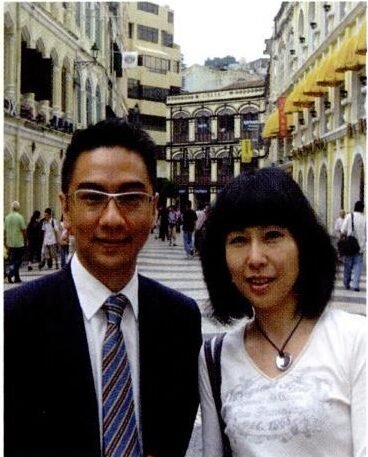
Macau’s hub, Senado Square, is a showcase of the region’s dual heritage. As I wander through the square on a steamy day, I’m reminded of a line from Harold Robbins’ pulp novel Sin City: “In Macao, you could drown on a lungful of air.” I walk past the altar-like façade of St. Paul’s. The ruins of the cathedral, which burned down in 1835, are the focal point of a vast UNESCO World Heritage site encompassing eight town squares and 22 historic buildings. A mosaic-tiled pathway leads me to the Museum of Macau, housed in a crenellated colonial fortress.
Inside, near a junk moored in a pool representing the inner harbor, is a streetscape of nascent Macau. The recorded clatter of mah-jong tiles sets the atmosphere.
Displays showcase the textile, fireworks, and toy industries crucial to the area’s development.
Another exhibit shows off some of Macau’s diminutive prize fighters: grand champion crickets, along with the bamboo rat-whisker “cricket ticklers” used to whip the critters into a fighting mood, and the tiny carved stone and wood coffins that sent the insects off in style.
A good bet, whether on bugs or black-jack, has always been popular in Macau, and the pounding of jackhammers competes with the metallic ping of patacas, the local currency, pouring into slot-machine trays in casinos along the Cotai Strip, a 250-acre swath of infill fusing the islands of Taipa and Colone. The king of the Strip is the $2.4 billion Venetian Macau Resort and Hotel, which is double the size of its Vegas namesake. The 3,000-suite complex with 350 shops will anchor a development of 14 upscale hotels with 20,000 guest rooms.
Seeking a tranquil counterpoint to glitz, rattle, and kitsch, I head to the A-Ma Temple with Anna Lam, 2007-08 president of the Rotary Club of Macau Central, who introduces me to her Rotarian brother, Francisco K.K. Lam.
The Lams are among the 10 founding families of the 1488 temple, a series of shrines carved into a lush hillside.
Since taking the helm nearly two years before, Francisco has overseen a massive makeover of the complex. Occupying one station are soothsayers who predict the future by tumbling numbered sticks from a cylinder. Anna and Francisco encourage me to give it a try.
They seem disappointed when I demur.
I’m not superstitious, but why jinx a trip that’s already been a pretty good roll?
Brad Webber is a freelance writer based in Chicago.
Making up in Macau
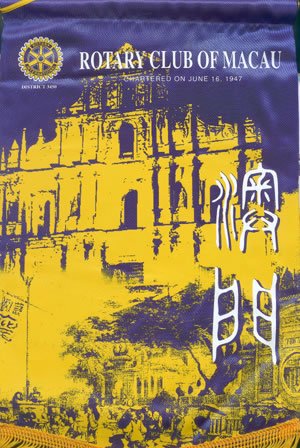
There are six Rotary clubs in Macau. The oldest, the Rotary Club of Macau, was chartered in 1947, and the newest, the Rotary Club of Taipa, in 2007. Join a rare Saturday meeting with the Rotary Club of Macau Islands at 6:30 p.m. at the Star World Hotel.