
by
Rotarian Jim Pringle
Last updated: 18-06-1998
Rtn Bob Wilson, of RC Hong Kong South, could hardly believe his eyes. He had been visiting a home on Hong Kong’s posh Peak to look at furniture and artifacts that were on sale, and had not found anything of interest. Then, on his way out, he glanced at a brass bell that was being used as a doorstop. There was a familiar emblem on top.
“I could hardly believe my eyes,” Bob recalled later. “In that moment, I realized I had made a real find.”
What Bob had discovered was a solid brass bell complete with the Rotary gear wheel symbol and the markings: ‘Stanley F. Howard, 20th August, 1925. Rotary Club of Peking’. Bob quickly established it was for sale, produced the asking price of HK$500 (US$65), and left clutching his trophy – a unique piece of history that somehow, for more than half a turbulent century, had survived mayhem, war and revolution in China.
It was in 1992 that Bob made his purchase and since then, as he assured 66 Rotary members and their guests on a warm summer night in Beijing, he had ‘not used the bell as a doorstop.’ He, and they, seemed to consider the find a good omen for the future of Rotary in China.
On 16th June, Rtn Hermann G. Heid, outgoing President of the ‘Rotarians in Beijing’, who were that night marking their 100th meeting with a sumptuous dinner – Beijing is still an offshoot of The Rotary Club of Hong Kong – accepted custody of the bell, now known as ‘the Bell’.
“I cannot tell you how delighted and exited I am to have witnessed the return of the Bell of the former RC of Peking to its roots,” Hermann said in the luxurious old China Club, with its ancient courtyards and pavilions. “This, to me, is an emotional home-coming of a symbol, a link between our predecessors and us! Its return makes us, I think, the legitimate successors of the original Rotary Club of Peking.”
‘Legitimate’ is the key word of the context. China is just beginning to have the makings of a civil society. Until now no organisation outside the umbrella of the Communist Party of China has been permitted to legally exist. Pending recognition of the Beijing Rotary Club by the Chinese government, RI has itself withheld recognition.
Yet a tacit recognition is already in place, and indeed, Mr. Xu Liugen, Director-General of the Ministry of Civil Affairs, which grants legitimacy to Non-Government Organizations (NGOs), was present and spoke of the high regard in which he, personally, holds Rotary.
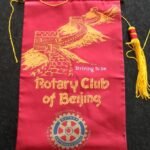
Describing the establishment of the ‘Striving to be, Rotary Club of Beijing,’ Hermann noted: “I personally never envisioned major obstacles from the Chinese side, as long as we would not try to force their hand, and stayed within the boundaries of the law, observing common courtesies towards our host country.”
Hermann, after two years at the helm stepped down on 30th June, told guests, as they consumed fillet of grass carp with sweet and sour sauce and duck smoked in camphor wood, that they had built friendly relations with various Chinese ministries, government agencies and charities, all of whom were fully aware of the Rotarians’ weekly meetings.
He recalled that RI Director Ed Hatcher had summed up the delicate situation in Beijing by saying: “If it looks like a Rotary Club, if it feels like a Rotary Club, and if it sounds like a Rotary Club – well, then, it must be a Rotary Club!”
And, Hermann added, as he struck the rediscovered Bell with a wooden mallet – it has a rich, resonant tone – “We will sound like a Rotary Club from now on!” Speaking beneath a red lantern-shaped as a lotus flower, Bob described how, after his discovery, he had written to Rotary’s world headquarters and found that the Peking Club had, indeed, originally been founded on 30th August 1924, a year before the date of the Bell.
Mr. Howard was the manager of the Peking office of American Express Co. Surviving the Japanese occupation of Peking, the Club was forced to terminate activities on 31st December 1943, well into the Second World War.
In August 1946, the Rotary Club of Peking was re-chartered only to be terminated again in June 1951, nearly two years after the People’s Republic of China was founded by Chairman Mao Zedong in 1949. ‘Peking,’ with the new government’s insistence, has now become ‘Beijing.’
Bob said that, in the opening days, the club had had 12 Chinese, 10 American and two British members, and it met every Wednesday in the once elegant, now defunct Hotel Wagons-Lits in the old Legation Quarter of China’s capital. “It is with great pleasure that I return this Bell after 73 years,” Bob concluded, “with the hope that it will become the property of a constituted Rotary Club of Beijing.” He would also like to see, he said, Rotary Clubs in ‘many other Chinese cities.’
During the proceedings, PDG Dom Vessigault of District 3450 (Hong Kong and Macau) gave a keynote address, full of Gallic humour. Danish Ambassador Rtn Christopher Bo Bramsen, quoting from the Hans Christian Andersen fairy tale, expressed the hope that the ‘ugly duckling’ of the unrecognised Beijing Club would soon grow into a ‘beautiful swan.’
Among the telegrams of congratulations was one from Percy Chu, Past President of the Shanghai Rotary Club between 1934-35, who at 101 years old is the only living Rotarian in the world who has met with Paul Harris, founder of Rotary. The meeting concluded in the customary way, but with one innovation – a clang by Hermann on the original Bell of the Rotary Club of Peking to the cheers of the gathering.
Source: http://www.rotary3450.org/district/history/peking_bell